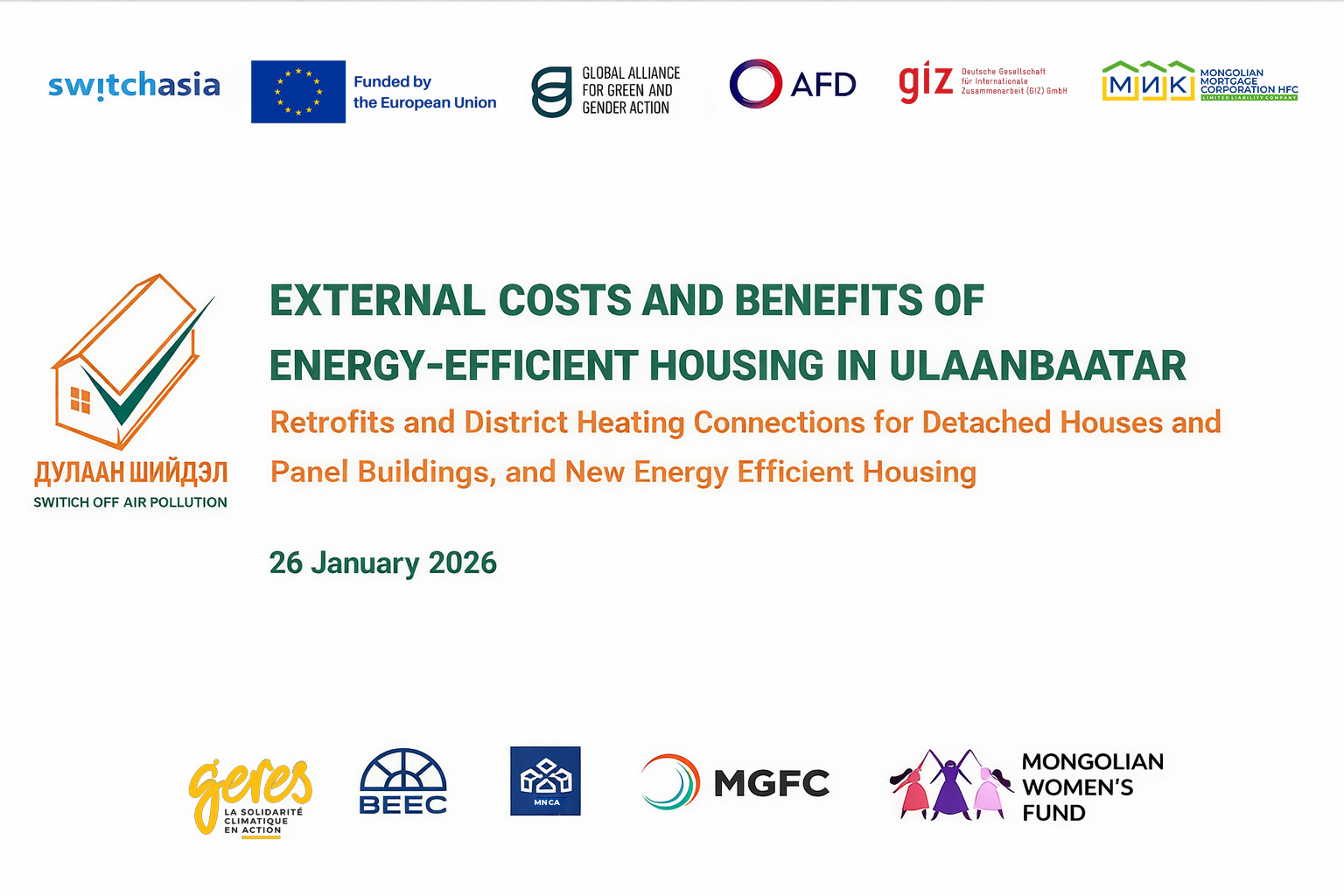
A comprehensive study assessing the externality (indirect) costs and benefits of energy-efficient solutions in the housing sector was conducted, and its findings were presented to relevant stakeholders. The study clearly demonstrates that energy-efficient housing plays a crucial role in reducing air pollution, protecting public health, and increasing long-term economic benefits.
The study was carried out under the “Sustainable Options for Air Pollution Reduction – Phase II (SOAP-II)” project, which is supported by the European Union Delegation to Mongolia, the EU SWITCH-Asia Programme, the Foundation for Housing, the Global Alliance for Green and Gender Action, and the Agence Française de Développement (AFD). Implementing partners are Geres Mongolia, Mongolian National Construction Association (NGO), Mongolian Green Finance Corporation and Mongolian Women's Fund. It evaluates and compares various housing interventions—such as insulation of detached houses, upgrading of prefabricated apartment buildings, and construction of new energy-efficient housing—from both financial and economic perspectives. A key feature of the study is that it quantifies, in monetary terms, the external costs and benefits arising from impacts on health, the environment, and climate.
According to the study’s findings, failure to implement energy-efficient housing measures results in annual social and environmental losses exceeding USD 357 million, while the economic returns of certain insulation measures reach as high as 69 percent. The study also shows that significant reductions in health-related costs associated with PM2.5 air pollution can be achieved.
The study was implemented with support from multiple funding partners, with the Mongolian Mortgage Corporation (MIK) participating as one of the financiers. MIK’s involvement reflects the institution’s strong commitment to supporting energy-efficient and sustainable solutions in the housing sector, as part of its responsible financing policy.
The study’s results are expected to play an important role in future housing policy development, the design of green finance products, and investment decision-making, providing a solid foundation for collaboration among banks, financial institutions, policymakers, and development partners.
MIK has reaffirmed that it will continue to support energy-efficient and green housing, as well as related research, initiatives, and financing solutions going forward.
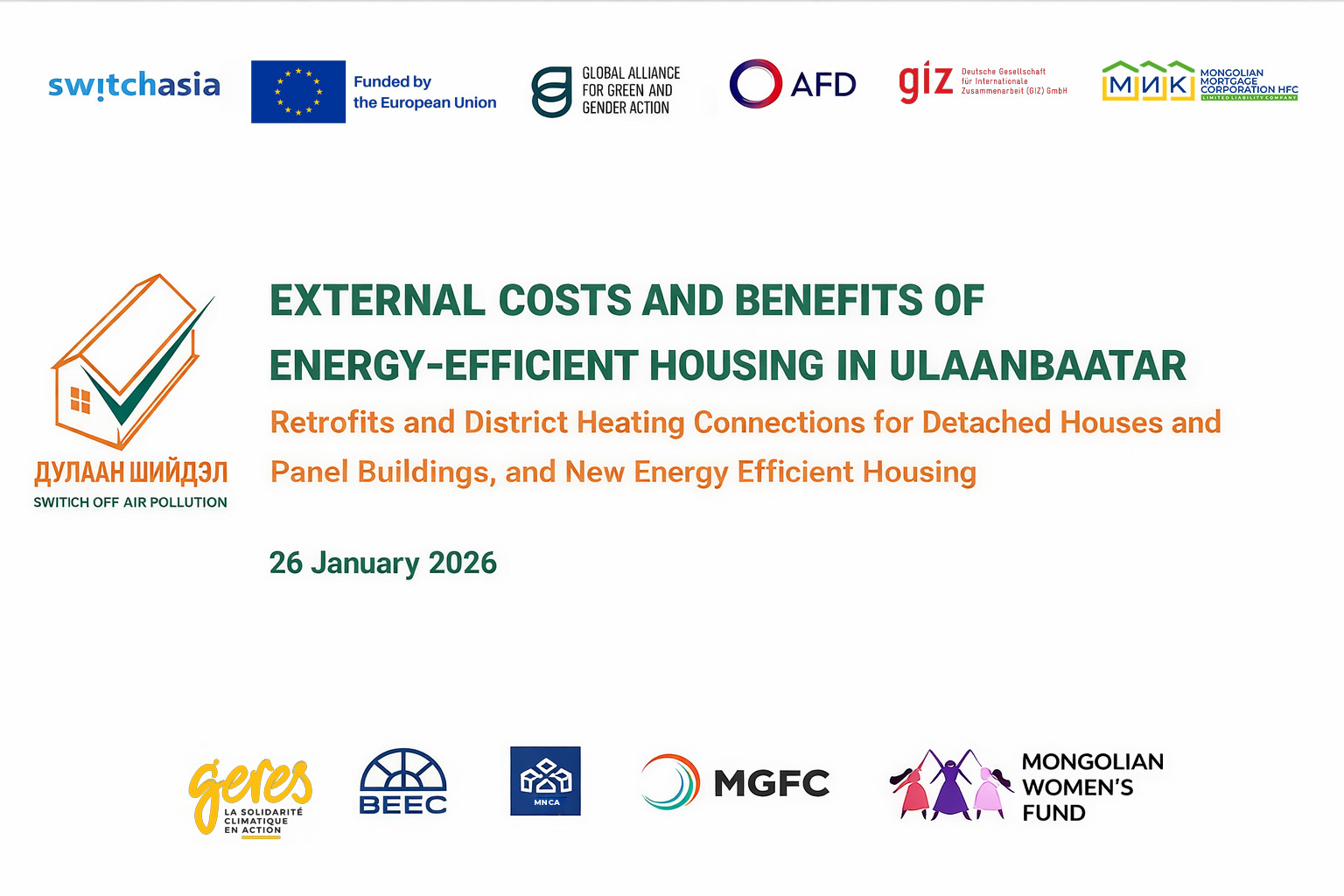
A comprehensive study assessing the externality (indirect) costs and benefits of energy-efficient solutions in the housing sector was conducted, and its findings were presented to relevant stakeholders. The study clearly demonstrates that energy-efficient housing plays a crucial role in reducing air pollution, protecting public health, and increasing long-term economic benefits.
The study was carried out under the “Sustainable Options for Air Pollution Reduction – Phase II (SOAP-II)” project, which is supported by the European Union Delegation to Mongolia, the EU SWITCH-Asia Programme, the Foundation for Housing, the Global Alliance for Green and Gender Action, and the Agence Française de Développement (AFD). Implementing partners are Geres Mongolia, Mongolian National Construction Association (NGO), Mongolian Green Finance Corporation and Mongolian Women's Fund. It evaluates and compares various housing interventions—such as insulation of detached houses, upgrading of prefabricated apartment buildings, and construction of new energy-efficient housing—from both financial and economic perspectives. A key feature of the study is that it quantifies, in monetary terms, the external costs and benefits arising from impacts on health, the environment, and climate.
According to the study’s findings, failure to implement energy-efficient housing measures results in annual social and environmental losses exceeding USD 357 million, while the economic returns of certain insulation measures reach as high as 69 percent. The study also shows that significant reductions in health-related costs associated with PM2.5 air pollution can be achieved.
The study was implemented with support from multiple funding partners, with the Mongolian Mortgage Corporation (MIK) participating as one of the financiers. MIK’s involvement reflects the institution’s strong commitment to supporting energy-efficient and sustainable solutions in the housing sector, as part of its responsible financing policy.
The study’s results are expected to play an important role in future housing policy development, the design of green finance products, and investment decision-making, providing a solid foundation for collaboration among banks, financial institutions, policymakers, and development partners.
MIK has reaffirmed that it will continue to support energy-efficient and green housing, as well as related research, initiatives, and financing solutions going forward.